๐Ÿ“ž 88558 10010 (Silver Leaf Clinic) ๐Ÿ“ž +91 20 6768 9704 (Landline) ๐Ÿ“ž 84118 08284 (Dr. Gore / WhatsApp)
Silver Leaf Clinic ยท Hadapsar, Pune
Homeโ†’ About Dr. Goreโ†’
Conditionsโ–ผ
Colon Cancer
Robotic & open colectomy
Pancreatic Cancer
Robotic Whipple ยท Distal Pancreatectomy
Stomach Cancer
D2 gastrectomy ยท Robotic
Proceduresโ–ผ
Whipple Procedure
Robotic GI Surgery
HIPEC Surgery
Contactโ†’ ๐Ÿ“ž Call 88558 10010
Homeโ€บConditionsโ€บPancreatic Cancer
GI Cancer ยท Pancreatic Cancer Surgery Pune

Pancreatic
Cancer โ€”
Whipple's & Distal Pancreatectomy, Pune.

Surgical resection is the only curative option for pancreatic cancer. Dr. Vinod T. Gore performs Robotic Whipple's (Pancreaticoduodenectomy), Robotic Distal Pancreatectomy (RAMPS), and complex vascular reconstructions โ€” with 300+ robotic procedures and FARIS certification from the University of Edinburgh.

๐Ÿค– Robotic Whipple's ยท FARIS Edinburgh ๐Ÿ”ฌ RAMPS ยท Distal Pancreatectomy 300+ Robotic Surgeries FOLFIRINOX ยท Perioperative Chemo Centre of Excellence ยท Sahyadri Manipal
Pancreatic Cancer โ€” Key Facts
Whipple
Pancreaticoduodenectomy โ€” head of pancreas
Most complex abdominal operation in GI surgery
RAMPS
Radical Antegrade Modular Pancreatosplenectomy
Body & tail tumours โ€” superior posterior margin
15โ€“20%
Patients resectable at presentation
Only surgery offers cure
5โ€“8h
Operating time โ€” Robotic Whipple
9โ€“12 days hospital stay
POPF
Pancreatic fistula โ€” key complication
Robotic reduces rate with precise anastomosis
Understanding the Disease

Types of Pancreatic Cancer

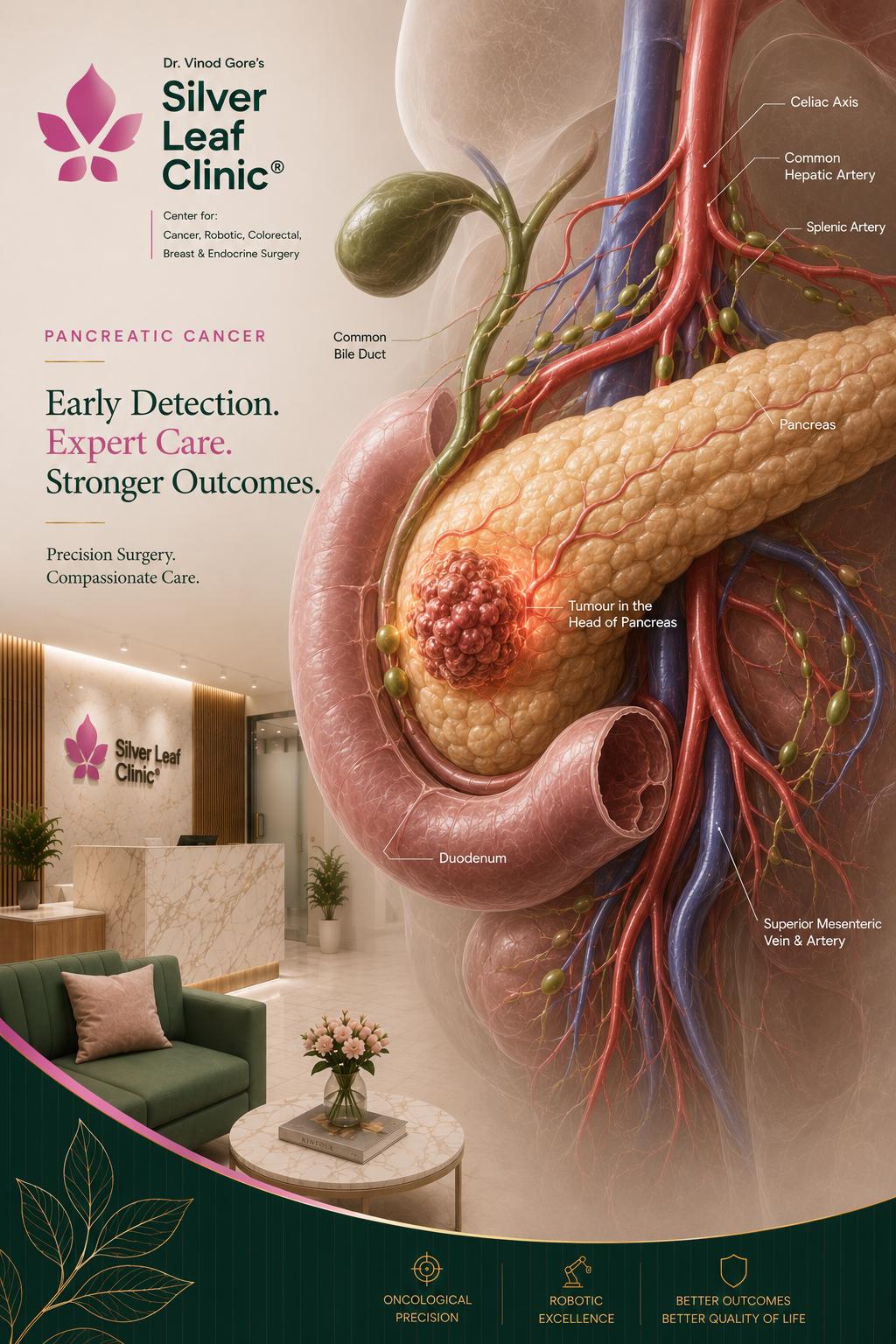
The pancreas is a gland behind the stomach with two functions: producing digestive enzymes (exocrine) and hormones like insulin (endocrine). Pancreatic cancer arises from the ductal epithelium in 85โ€“90% of cases (Pancreatic Ductal Adenocarcinoma โ€” PDAC) and is notoriously difficult to detect early.

60โ€“70% of tumours arise in the head of the pancreas โ€” where they obstruct the bile duct, causing painless jaundice. Body and tail tumours cause vague back pain and weight loss, and are often diagnosed at a later stage as they cause no jaundice.

Despite its challenging reputation, surgical resection with adjuvant chemotherapy (FOLFIRINOX) offers genuine long-term survival and cure in fit patients with resectable disease. The key is expert evaluation โ€” many patients told their cancer is inoperable elsewhere have been successfully resected at specialist centres.

Warning Signs โ€” Do Not Ignore
๐ŸŸก
Painless jaundice
Yellow skin + dark urine + pale stools โ€” head of pancreas
โš–๏ธ
Rapid weight loss
Often 10โ€“15 kg by the time of diagnosis
๐Ÿ˜ฃ
Back pain
Dull persistent ache โ€” body or tail tumour on coeliac plexus
๐Ÿฉบ
New-onset diabetes
Especially rapid-onset, over 50 years of age โ€” investigate
๐Ÿ˜ค
Pancreatitis without cause
Ductal obstruction can trigger acute pancreatitis as first sign
Pancreatic Ductal Adenocarcinoma (PDAC)
85โ€“90%
+
The most common and most aggressive pancreatic tumour. Arises from the ductal epithelium. Often presents late โ€” 60โ€“70% of cases are in the head of pancreas, typically causing obstructive jaundice. PDAC carries a challenging prognosis, but surgical resection offers the only chance of cure.
Ampullary Carcinoma
5โ€“8%
+
Arises at the Ampulla of Vater โ€” where the bile duct and pancreatic duct meet. Causes early obstructive jaundice, so is often caught at a more resectable stage. Significantly better prognosis than PDAC after Whipple resection โ€” 5-year survival 30โ€“50%.
Distal Bile Duct Cancer (Cholangiocarcinoma)
3โ€“5%
+
Distal cholangiocarcinoma involves the bile duct at the level of the head of the pancreas โ€” treated with Whipple's procedure. Distinguished from hilar (Klatskin) cholangiocarcinoma which is not a pancreatic operation.
Pancreatic Neuroendocrine Tumour (pNET)
3โ€“5%
+
Arise from the islet cells of the pancreas. Functional NETs (insulinoma, gastrinoma, glucagonoma) cause hormonal syndromes. Non-functional NETs are usually larger at presentation. Generally better prognosis than PDAC. Surgery is curative for localised disease.
Cystic Pancreatic Neoplasms
Rising incidence
+
IPMN (Intraductal Papillary Mucinous Neoplasm), mucinous cystadenoma, and serous cystadenoma โ€” increasingly found incidentally on imaging. Worrisome features (mural nodules, main duct dilatation, rapid growth) require surgical resection. IPMN can progress to invasive cancer.
Staging & Resectability

Is Pancreatic Cancer Operable?

The most important staging question in pancreatic cancer is the relationship of the tumour to the major blood vessels (superior mesenteric artery, coeliac axis, portal vein, and superior mesenteric vein). CT with pancreatic protocol (triphasic) + PET-CT + EUS provides this information.

Resectable
15โ€“20% of presentations
No tumour contact with the SMA, coeliac axis, or SMV/PV. Suitable for upfront Whipple's (head) or distal pancreatectomy (body/tail) followed by adjuvant chemotherapy.
Upfront surgery โ†’ Adjuvant FOLFIRINOX or Gemcitabine + Capecitabine
Borderline Resectable
10โ€“15% of presentations
Tumour contacts but does not fully encase the SMA, SMV, or portal vein (<180 degrees). Neoadjuvant FOLFIRINOX is given first to downsize the tumour โ€” then restaged.
Neoadjuvant FOLFIRINOX ร— 4โ€“6 cycles โ†’ restaging โ†’ surgery if downstaged
Locally Advanced
30โ€“35% of presentations
Tumour encases (>180 degrees) the SMA or coeliac axis. Not primarily resectable. Systemic chemotherapy is the primary treatment. A small proportion may downstage enough for surgical resection.
FOLFIRINOX or Gem+nab-Paclitaxel โ†’ occasional downstaging to surgery
โš ๏ธ Important: Many patients told their cancer is inoperable at other centres have been successfully resected by specialist surgeons with expertise in vascular reconstruction. A second opinion from a dedicated pancreatic cancer surgeon โ€” reviewing the original CT โ€” is always worthwhile for borderline resectable disease.
Treatment Pathway

From Diagnosis to Surgery & Recovery

Every pancreatic cancer case follows an MDT-guided pathway. The sequence of chemotherapy and surgery depends on the resectability category โ€” with neoadjuvant FOLFIRINOX now standard for borderline resectable disease.

01
Step 01
CT Staging + CA 19-9
Contrast CT chest/abdomen/pelvis (pancreatic protocol โ€” triphasic) is the key staging investigation. MRCP for ductal anatomy. EUS + FNA for tissue diagnosis in borderline cases. CA 19-9 blood test.
02
Step 02
MDT Tumour Board
Every pancreatic cancer case reviewed at MDT โ€” surgical oncologist, medical oncologist, radiologist, gastroenterologist, and pathologist. The resectability category determines the treatment sequence.
03
Step 03
Biliary Decompression
For jaundiced patients requiring neoadjuvant chemotherapy โ€” ERCP with biliary stent placement to relieve jaundice before systemic treatment begins. For direct surgical candidates โ€” preoperative stenting is avoided where possible.
04
Step 04
Neoadjuvant / Upfront Surgery
Resectable disease: upfront Whipple's or distal pancreatectomy. Borderline resectable: FOLFIRINOX ร— 4โ€“6 cycles โ†’ restaging CT โ†’ surgery if response. Neoadjuvant therapy improves R0 resection rates.
05
Step 05
Whipple's or Distal Pancreatectomy
Robotic Whipple's (pancreaticoduodenectomy) for head/neck/uncinate tumours. Robotic distal pancreatectomy (RAMPS) for body/tail tumours. Vascular resection and reconstruction of the SMV/portal vein where required.
06
Step 06
Adjuvant Chemotherapy
Modified FOLFIRINOX (mFOLFIRINOX) ร— 12 cycles or Gemcitabine + Capecitabine ร— 6 months โ€” both are current adjuvant standards. Begins 6โ€“8 weeks post-operatively once surgical recovery is complete.
๐Ÿค– Robotic Whipple's ยท da Vinci Xi ยท FARIS Edinburgh ยท 300+ Robotic Procedures
Robotic Whipple's โ€” Precision Where It Matters Most.

The Whipple procedure (pancreaticoduodenectomy) is one of the most complex operations in all of surgery โ€” involving dissection at the root of the superior mesenteric artery, three separate anastomoses, and the technically demanding pancreaticojejunostomy. The robotic platform's 10ร— magnified 3D vision and 7-degree wristed instruments bring decisive advantages precisely where they are needed most.

Studies consistently show robotic Whipple's achieves significantly less blood loss, a lower post-operative pancreatic fistula rate, shorter hospital stay, and faster recovery. Dr. Gore holds the internationally recognised FARIS certification from the University of Edinburgh and has performed 300+ robotic procedures.

  • Superior 3D visualisation at SMA/SMV root โ€” the most critical dissection plane
  • Precise duct-to-mucosa pancreaticojejunostomy โ€” reduces POPF rate significantly
  • Less blood loss โ€” especially important around the portal vein and SMV
  • Faster recovery โ€” adjuvant FOLFIRINOX begins on schedule
  • Shorter hospital stay vs open Whipple โ€” 9โ€“12 days vs 10โ€“14 days
  • 300+ robotic procedures by Dr. Gore ยท FARIS ยท Centre of Excellence
๐Ÿ…
FARIS โ€” University of Edinburgh
Fellowship in Advanced Robotic & Innovative Surgery. One of the most rigorous robotic surgery certifications available globally. Dr. Gore is among the very few FARIS Fellows in India.
โญ
Centre of Excellence
Sahyadri Manipal Hospital, Pune โ€” designated Robotic Cancer Surgery Centre of Excellence. Accredited ARIS training centre for robotic surgery.
๐Ÿ”ฌ
300+ Robotic Procedures
Dr. Gore has performed over 300 robotic procedures including Whipple's, gastrectomy, colectomy, esophagectomy, and hepatic resection โ€” one of the most experienced robotic oncosurgeons in India.
๐ŸŽ“
FARIS Training Mentor
Dr. Gore trains and certifies other robotic surgeons at the Centre of Excellence โ€” one of very few accredited FARIS training mentors in India.
๐Ÿ’ก
ICG Fluorescence Integration
ICG fluorescence is used during robotic Whipple's to confirm blood supply to the pancreatic anastomosis, identify the biliary anatomy, and guide resection margins.
What Makes Whipple's So Complex

The 3 Anastomoses of Whipple's Procedure

After removing the head of the pancreas, duodenum, bile duct, and gallbladder โ€” the digestive tract must be reconstructed with three separate joins. The precision and technique of each anastomosis determines the complication rate. This is where the robotic platform's advantages are most meaningful.

01
Pancreaticojejunostomy
The Most Critical โ€” Highest Risk
The join between the pancreatic remnant (cut end of the pancreas) and the jejunum โ€” the most technically demanding and highest-risk anastomosis in all of abdominal surgery. A failure here leads to leakage of activated pancreatic enzymes โ€” causing severe inflammation, haemorrhage, and sometimes death.
๐Ÿค– Robotic wristed instruments allow duct-to-mucosa suturing with 7ยฐ precision โ€” reducing POPF rate
02
Hepaticojejunostomy
Bile Duct to Jejunum Join
The join between the cut end of the common bile duct and the jejunum โ€” restoring bile drainage from the liver. This anastomosis is critical for long-term liver function. Bile leak from a failed hepaticojejunostomy is a serious complication. The robotic platform provides superior access at the porta hepatis.
๐Ÿค– 3D vision at porta hepatis โ€” precise single-layer interrupted suturing with no ischaemia risk
03
Gastrojejunostomy
Stomach (or Pylorus) to Jejunum
The join between the stomach (or preserved pylorus in PPPD) and the jejunum โ€” restoring the passage of food. Delayed Gastric Emptying (DGE) is the most common functional complication of the Whipple procedure, occurring in 20โ€“40% of patients. The pylorus-preserving modification (PPPD) is performed routinely by Dr. Gore.
๐Ÿค– PPPD โ€” pylorus-preserving technique minimises delayed gastric emptying
Surgical Procedures

All Pancreatic Cancer Operations

The surgical approach depends on the location of the tumour within the pancreas. Head and neck tumours require Whipple's. Body and tail tumours require distal pancreatectomy (RAMPS). Diffuse tumours occasionally require total pancreatectomy.

๐Ÿฅ
Complex Vascular Involvement ยท Borderline Resectable
Open Whipple's Procedure
Open Pancreaticoduodenectomy
โฑ 5โ€“8 hours๐Ÿฅ 10โ€“14 days
Open Whipple's is preferred for borderline resectable tumours requiring portal vein or SMV resection and reconstruction, cases with dense adhesions, or very large tumours where robotic access is limited.
  • Preferred for portal vein / SMV involvement
  • Segmental vascular resection and reconstruction
  • Best for bulky or adherent tumours
  • Equivalent oncological outcomes to robotic
๐Ÿ”ฌ
Body & Tail ยท RAMPS ยท Oncological Standard
Robotic Distal Pancreatectomy
RAMPS โ€” Radical Antegrade Modular Pancreatosplenectomy
โฑ 3โ€“5 hours๐Ÿฅ 7โ€“9 days
Distal pancreatectomy removes the body and tail of the pancreas. For pancreatic cancer, Dr. Gore performs RAMPS โ€” a technique that dissects the retroperitoneal plane anterior to the left adrenal gland, achieving a superior posterior margin.
  • Removes: body + tail of pancreas + spleen (en bloc)
  • RAMPS technique โ€” superior posterior margin
  • Retroperitoneal dissection to left adrenal plane
  • Robotic: precise splenic vessel dissection
โญ•
Diffuse Disease ยท Multi-focal IPMN ยท Selected Cases
Total Pancreatectomy
Total Pancreatectomy ยท Selected Cases Only
โฑ 5โ€“7 hours๐Ÿฅ 10โ€“14 days
Total pancreatectomy removes the entire pancreas โ€” indicated for diffuse IPMN with main-duct involvement, multi-focal pancreatic cancer, or completion pancreatectomy. Results in insulin-dependent diabetes requiring careful long-term management.
  • Entire pancreas removed โ€” exocrine and endocrine
  • Results in insulin-dependent diabetes (brittle)
  • Pancreatic enzyme replacement lifelong (PERT)
  • Only performed when clearly necessary
Borderline Resectable Disease

Vascular Resection & Reconstruction

For borderline resectable tumours with portal vein or SMV involvement โ€” vascular resection and reconstruction extends the possibility of complete R0 resection to patients who would otherwise be considered inoperable. This is the frontier of pancreatic cancer surgery.

Portal Vein / SMV Resection
For borderline resectable tumours with โ‰ค180ยฐ involvement of the portal vein or SMV โ€” tangential (wedge) resection or segmental resection with end-to-end anastomosis. Does not improve survival compared to R0 resection without vascular involvement, but enables R0 resection in otherwise irresectable tumours. Performed open or robotically depending on extent.
Arterial Involvement
SMA or coeliac axis involvement (>180ยฐ) is generally considered a contraindication to resection โ€” arterial reconstruction after pancreatectomy carries very high morbidity and mortality. Rare selected centres perform distal pancreatectomy with coeliac axis resection (DP-CAR) for coeliac-involved tumours โ€” this requires extreme surgical expertise and careful patient selection.
Surgical Complications

Understanding Post-Whipple Complications

Whipple's procedure has a complication rate of 40โ€“60% at most centres โ€” though the majority are minor. Major complications are managed at the bedside or with radiological intervention. Mortality at specialist high-volume centres is now under 3%.

Post-operative Pancreatic Fistula (POPF)
Grade B/C โ€” clinically significant
15โ€“25% (Whipple) ยท 20โ€“30% (DP)+
Leakage of pancreatic juice from the pancreatic anastomosis (Whipple) or staple line (DP). Managed with prolonged drain, octreotide, antibiotics, and occasionally radiology-guided drainage. Grade C POPF causing haemorrhage may require reoperation. Robotic Whipple reduces POPF rate with precise duct-to-mucosa anastomosis.
Delayed Gastric Emptying (DGE)
Grade B/C
20โ€“40% (Whipple)+
Failure of normal gastric function after Whipple. Presents as inability to tolerate oral intake, nausea, vomiting. Managed with nasogastric decompression, prokinetics, nutritional support. Usually resolves in 2โ€“4 weeks. Pylorus-preserving PPPD may reduce DGE rates.
Post-pancreatectomy Haemorrhage (PPH)
Grade B/C
3โ€“8%+
Bleeding after pancreatectomy โ€” either early (from raw surfaces) or late (from pseudoaneurysm formation secondary to POPF). Late PPH requires urgent angiography and embolisation or reoperation. The most dangerous post-Whipple complication.
Patient Questions

Frequently Asked Questions โ€” Pancreatic Cancer

What is Whipple's procedure and who needs it?+

Whipple's procedure (pancreaticoduodenectomy) removes the head of the pancreas, entire duodenum, distal bile duct, and gallbladder. It is performed for cancers of the head of the pancreas, ampullary cancer, distal bile duct cancer, and duodenal cancer. It is one of the most complex abdominal operations in surgery โ€” requiring an experienced surgeon at a high-volume centre. Dr. Gore performs the pylorus-preserving variant (PPPD) as standard, along with robotic-assisted technique for eligible patients.

Is robotic Whipple's surgery safe and better than open?+

Robotic Whipple's has been shown in multiple international studies to be safe and to offer specific advantages over open surgery โ€” particularly in terms of blood loss, hospital stay, and the precision of the pancreaticojejunostomy anastomosis (reducing post-operative pancreatic fistula rates). The oncological outcomes โ€” R0 resection margins, lymph node yield, and long-term survival โ€” are equivalent to open surgery. Dr. Gore has performed 300+ robotic procedures and holds the FARIS certification from the University of Edinburgh.

What is distal pancreatectomy and is it different from Whipple's?+

Distal pancreatectomy removes the body and tail of the pancreas โ€” used for cancers of the pancreatic body and tail. Whipple's removes the head of the pancreas. They are completely different operations for tumours in different parts of the gland. For cancer, Dr. Gore performs RAMPS (Radical Antegrade Modular Pancreatosplenectomy) โ€” achieving better posterior resection margins by dissecting anterior to the left adrenal gland.

What is a Post-operative Pancreatic Fistula (POPF)?+

POPF is a leakage of pancreatic juice from the pancreatic anastomosis after Whipple's or from the staple line after distal pancreatectomy. It occurs in 15โ€“30% of cases and is the most common serious complication of pancreatic surgery. Grade B (requiring intervention) is managed with prolonged drain, octreotide, and antibiotics. Grade C (causing haemorrhage or sepsis) may require reoperation. Robotic Whipple's reduces POPF rates through more precise duct-to-mucosa pancreaticojejunostomy.

What is borderline resectable pancreatic cancer?+

Borderline resectable pancreatic cancer means the tumour contacts but does not fully encase the major blood vessels โ€” <180 degrees of vessel involvement. These tumours cannot safely be removed upfront, but may become resectable after neoadjuvant FOLFIRINOX chemotherapy (4โ€“6 cycles). After neoadjuvant therapy, restaging CT determines whether surgery is now feasible. Vascular resection and reconstruction may still be required at surgery.

What chemotherapy is used for pancreatic cancer?+

For resectable disease after surgery: modified FOLFIRINOX (5-FU, leucovorin, irinotecan, oxaliplatin) or Gemcitabine + Capecitabine are the two standard adjuvant regimens. For borderline resectable or locally advanced disease: FOLFIRINOX (4โ€“6 cycles) or Gemcitabine + nab-Paclitaxel (Abraxane) as neoadjuvant therapy. For metastatic disease: FOLFIRINOX or Gem+nab-Paclitaxel as palliative first-line.

What is the recovery after Whipple's procedure?+

After robotic Whipple's: ICU or HDU overnight, hospital 9โ€“12 days. A drain is left near the pancreatic anastomosis โ€” removed when drain fluid amylase is low. Diet progresses from clear fluids to soft food over 7โ€“10 days. Pancreatic enzyme replacement (Creon) is prescribed to aid digestion. Full recovery takes 8โ€“12 weeks. Adjuvant chemotherapy begins 6โ€“8 weeks post-operatively. Open Whipple's: hospital 10โ€“14 days, recovery 10โ€“14 weeks.

Book a Consultation
Pancreatic Cancer
Surgery
Consultation, Pune.

Bring your CT (pancreatic protocol), PET-CT, MRCP, EUS report, and CA 19-9. Dr. Gore will independently review all imaging and give an honest assessment of resectability โ€” including vascular involvement and whether neoadjuvant FOLFIRINOX is appropriate.

๐Ÿ“ Silver Leaf Clinic
511, City Centre, Solapur Road, Opp. Vaibhav Theatre, Hadapsar, Pune 411028
๐Ÿ“ Open in Google Maps
Dr. Vinod Gore's
Silver Leaf Clinicยฎ
Robotic Whipple's ยท RAMPS ยท Distal Pancreatectomy ยท FOLFIRINOX
Consultations at Silver Leaf Clinic, Hadapsar. Robotic Whipple's and distal pancreatectomy at Sahyadri Manipal Hospital โ€” Pune's Robotic Cancer Surgery Centre of Excellence.
Monday โ€“ Saturday10:00 AM โ€“ 6:00 PM
SundayBy Prior Appointment
Landline+91 20 6768 9704
Call Silver Leaf Clinic
88558 10010
Call โ†’