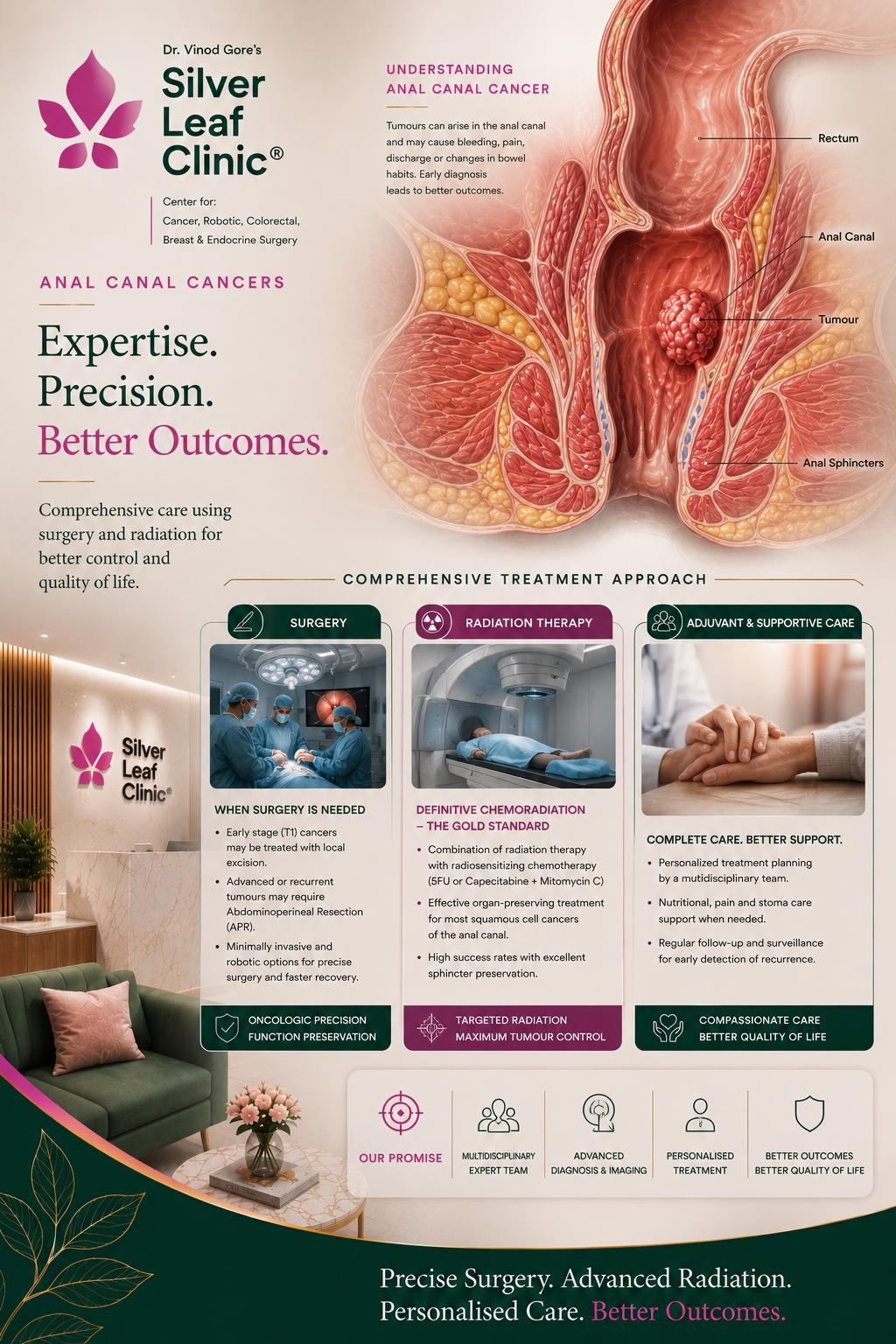
Anal canal cancer is one of the few GI cancers where surgery is NOT the primary treatment. The Nigro protocol โ chemoradiation with 5-FU and Mitomycin C โ achieves complete tumour eradication in 60โ80% of patients, preserving the anus and sphincter entirely. Surgery (APR) is reserved for residual or recurrent disease only.
Anal canal cancer arises in the anal canal โ the short passage (3โ4 cm) between the rectum and the anal verge. The most common type is Squamous Cell Carcinoma (SCC), which accounts for 85โ90% of cases and is strongly linked to Human Papillomavirus (HPV). Crucially, anal canal SCC is highly radiosensitive โ meaning it responds exceptionally well to radiotherapy combined with chemotherapy. This is why the primary treatment is chemoradiation โ not surgery.
Anal canal cancer must be distinguished from perianal skin cancer (arising outside the anal verge โ small lesions may be locally excised) and anorectal adenocarcinoma (managed as low rectal cancer with rectal cancer protocols). Each has a different treatment pathway.
Anal canal squamous cell carcinoma is one of the most clearly understood cancers in terms of causation. HPV โ specifically HPV-16 and HPV-18 โ is the dominant driver.
Anal canal cancer is often diagnosed late because its symptoms are commonly attributed to benign conditions. Any persistent perianal symptom lasting more than 4โ6 weeks must be formally examined.
Staging requires MRI pelvis (T and N staging), PET-CT (nodal and distant staging), and clinical EUA. HIV testing is mandatory for all patients.
| T Stage | Description | Treatment |
|---|---|---|
T1 | Tumour โค2 cm in greatest dimension | Chemoradiation โ complete response expected in >85% |
T2 | Tumour 2โ5 cm | Standard Nigro chemoradiation โ 5-FU + MMC + 50โ54 Gy |
T3 | Tumour >5 cm | Higher radiation dose (54โ60 Gy) + chemotherapy. Diverting colostomy may be needed for large fungating tumours |
T4 | Tumour invades adjacent organs (vagina, urethra, bladder) | Chemoradiation ยฑ neoadjuvant induction chemotherapy. Upfront diverting colostomy for fistulating disease. APR if chemoradiation fails |
N+ | Regional nodal involvement (mesorectal, internal iliac, inguinal) | Extended radiation field to include involved nodes. Inguinal nodal disease included in RT field |
M1 | Distant metastases โ liver, lung | Systemic chemotherapy (carboplatin + paclitaxel or 5-FU + cisplatin). Chemoradiation for local symptom control |
The structured pathway from diagnosis through chemoradiation, response assessment, and โ where needed โ salvage APR.
Abdominoperineal Resection (APR) is required in a minority of anal canal cancer patients โ those who do not achieve complete response to chemoradiation, those who relapse, and those with certain T4 tumours.
Abdominoperineal Resection (APR) removes the rectum, entire anus, and sphincter complex โ creating a permanent sigmoid end colostomy. For anal cancer, APR is a salvage or selective upfront operation โ not the primary treatment. It is primarily used when chemoradiation has failed to achieve or maintain complete response.
No โ and this is the most important fact about anal canal cancer. Anal canal squamous cell carcinoma is primarily treated with chemoradiation โ the Nigro protocol (5-FU + Mitomycin C + radiotherapy). Complete clinical response is achieved in 60โ80% of patients, preserving the anus and sphincter entirely. Surgery (APR) is reserved for patients with residual disease at 26 weeks, local recurrence, or those with T4 disease causing a fistula.
The Nigro protocol was introduced by Dr. Norman Nigro in 1974 โ combining 5-Fluorouracil (5-FU) infusion and Mitomycin C chemotherapy with concurrent external beam radiotherapy (50โ60 Gy over 5โ6 weeks). It achieves complete response in 60โ80% of patients, with 5-year survival of 65โ75% for localised disease. It transformed anal cancer from a disease requiring permanent colostomy to one where the anus is preserved in most patients.
Salvage APR is Abdominoperineal Resection performed for residual or recurrent anal canal cancer after primary chemoradiation has failed. It removes the rectum, anus, and sphincter complex, creating a permanent end colostomy. It is needed when: biopsy confirms residual SCC at 26 weeks; local recurrence occurs; or T4 disease with sphincter destruction makes organ preservation impossible.
Yes โ strongly. HPV (Human Papillomavirus), particularly HPV-16 and HPV-18, is detected in over 85% of anal canal squamous cell carcinomas. Anal cancer is one of the clearest examples of a vaccine-preventable cancer. The HPV vaccine (Gardasil) is highly effective in preventing the HPV strains responsible. HIV-positive individuals have a 30โ40ร increased risk โ annual anal cytology screening is recommended for this group.
After salvage APR for anal cancer, the perineal wound is in a previously irradiated field โ radiation damages blood supply and healing capacity. Direct closure leads to wound breakdown in 30โ60% of patients. The VRAM (Vertical Rectus Abdominis Myocutaneous) flap brings non-irradiated, well-vascularised tissue from the anterior abdominal wall into the perineal defect โ healing reliably. It is the gold standard reconstruction after salvage APR.
After confirming complete response, patients enter structured surveillance: clinical examination + digital rectal examination every 3 months for 2 years, then 6-monthly to 5 years. MRI pelvis every 6 months for 2 years. PET-CT if recurrence is suspected. Biopsy only if there is clear clinical or imaging evidence of recurrence โ not as a routine surveillance tool.
Bring your MRI pelvis, PET-CT scan, biopsy report, HIV test, and any previous treatment records. Dr. Gore will review all imaging and discuss whether chemoradiation alone is appropriate or whether APR is indicated โ including the full VRAM reconstruction plan if surgery is needed.
๐